
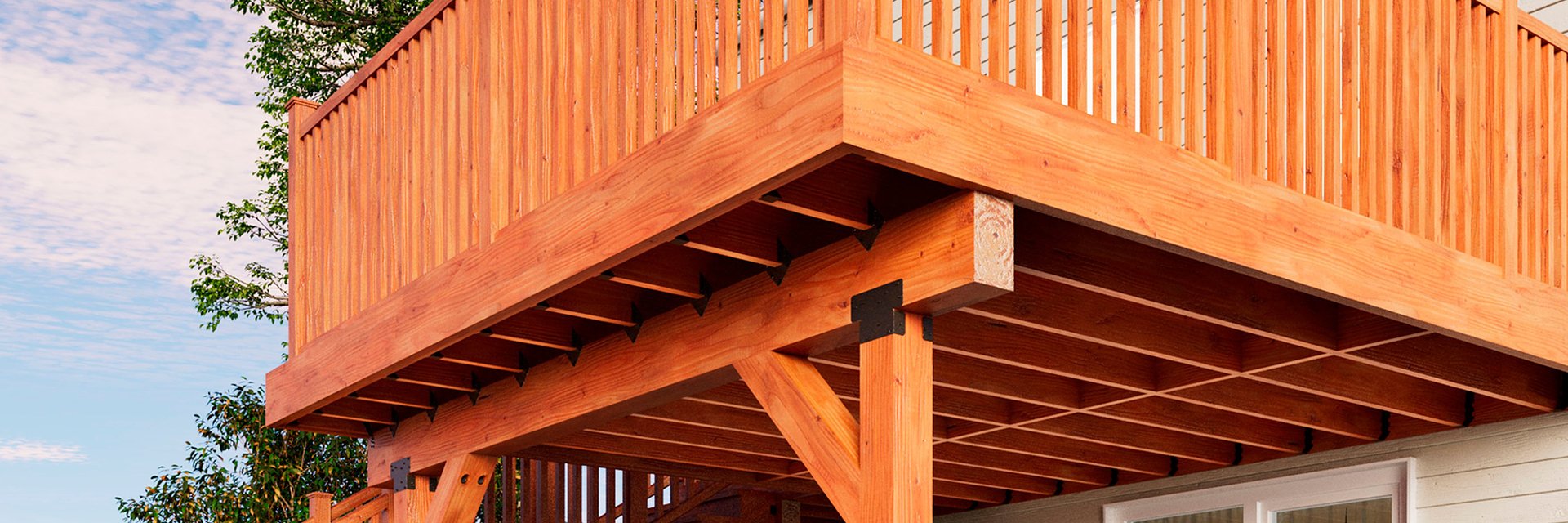
Out of 60 million existing decks, it’s estimated that half are past their useful life and need to be replaced. What’s worse, experts believe that many of these decks are potentially unsafe. The consequences can be catastrophic: Between 2020 and 2024 alone, approximately 8,700 people were injured and two people died due to collapses or floors giving way on decks, porches and balconies, according to statistics from the Consumer Product Safety Commission as reported in Consumer Reports.
Along with regular maintenance, it’s critical that homeowners and/or their contractor partners properly inspect existing decks on a regular basis.
5 Things to Look For on an Existing Deck
Decks should be inspected at least annually, ideally prior to seasons when the deck is used most often. Following are five areas to examine to determine overall safety and compliance with building codes:
1. Improper Connections: Any connections that do not meet the requirements of the code and manufacturer can compromise the safety of the deck. In many cases, toenailing (i.e., joining two wood members with angled nailing) does not constitute a proper connection. Connectors must be installed with the correct fastener.
2. Loose Connections: Vital connections may have degraded. Wobbly railings, loose stairs and ledgers that appear to be pulling away from the adjacent structure are all causes for concern.
3. Corrosion: Metal connectors and fasteners can corrode, especially if a product with insufficient corrosion resistance was originally installed.
4. Decay: Wood can decay with exposure to the elements. Deck framing members that have decayed may no longer be able to perform the function for which they were intended.
5. Splitting: As wood ages, it is common for splitting to develop. Large cracks or excessive splitting can weaken deck framing members.
Critical Deck Connections Checklist
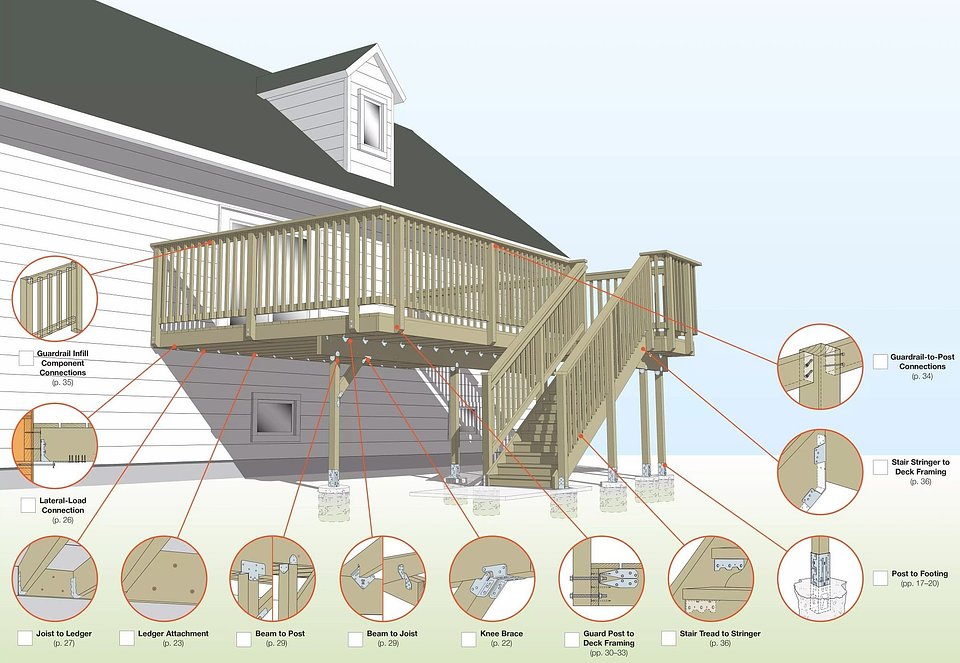
To build a safe, building-code-compliant deck, it’s essential that the deck construction establish a continuous load path using a system of key connections throughout the deck framing. When this system of connections is made properly, loads are transferred through the deck frame and into the ground and/or the adjacent structure to which the deck is connected.
The connections listed and illustrated below are necessary in order to create an effective continuous load path. Use the diagram to determine which deck connections are needed for new construction or which may need to be retrofitted for existing construction. Details on each connection type, as well as ledger connections to concrete and/or brick, can be found in Simpson Strong-Tie’s Deck Connection and Fastening Guide.
· Guardrail infill component connections
· Guardrail-to-post connections
· Lateral-load connections
· Joist-to-ledger connections
· Ledger attachments
· Beam-to-post connections
· Joist-to-beam connections
· Knee braces
· Stair-stringer-to-deck-framing connections
· Stair-tread-to-stringer connections
· Guard-post-to-deck-framing connections
· Post-to-footing connections

For full instructions on how to recognize defects and deficiencies in existing decks, plus guidance for building strong, safe, long-lasting deck structures, download the Deck Connection and Fastening Guide. It goes detail by detail through a typical deck and identifies relevant building code requirements and connection options.